The Firing (2)

Kiln reaching temperature

“YOU HAVE TO LIVE WITH THE THREAT OF FAILURE ALL THE TIME!”

I am going to talk about glazing the pots at a later stage as there is much to talk about regarding mixing and applying glazes. Suffice it to say that glazes were a key ingredient to the individuality, invention and exploration that epitomises the studio pottery at Greendene.

It came to the day of the firing in the big brick kiln out the back behind the studio. A few days before we had collected fire wood and stacked it up by the kiln. There was always plenty of logs due to the need to cut back the woodland areas that were threatening to invade the house and garden. I had hacked down and sawn Ash, Beech and Elderberry that had that strange musty earth scent. This was part of my continuing gardening duties.

The kiln had been stacked and the door bricked up with one brick lose to enable viewing inside the kiln to check the temperature.

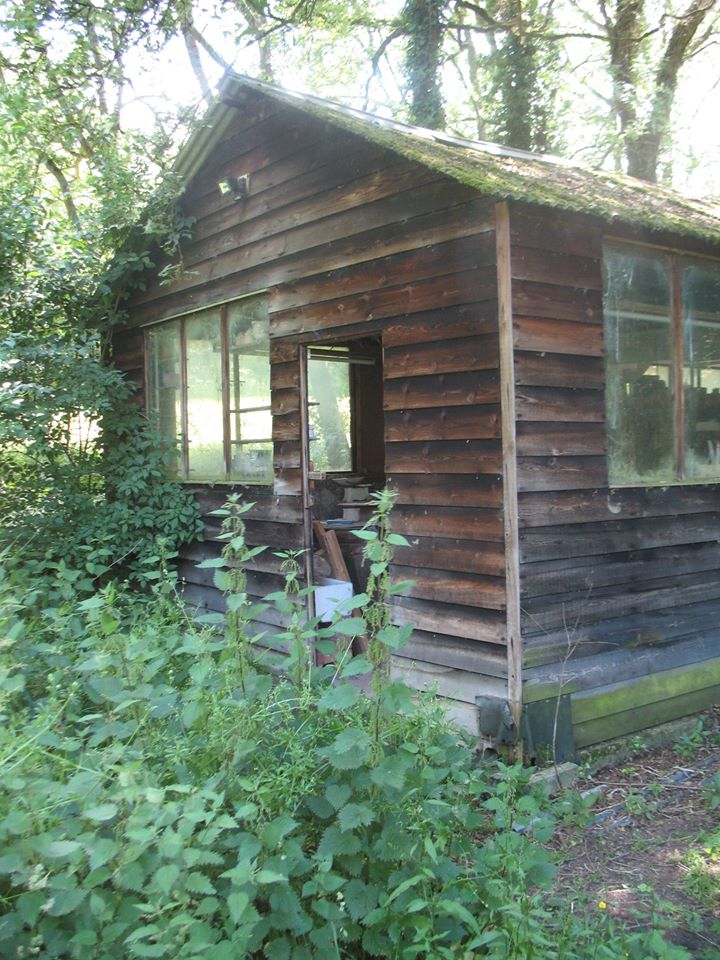
Behind the Studio

We started with a rather modest little fire in the fire box and gradually built it up. After several hours the pile of logs had slowly gone down and the temperature built up to a warm satisfying glow.

Once a certain temperature was reached, judgements were made by discussion between Mike and Denis, deciding on when the blower engine should be started. It was an old petrol fuelled engine and had to be cranked up to get started. Michael did the pulling and the engine huffed and puffed spluttered and went out. He tried again and once again the engine started into life and then died. Worried faces: again he pulled on the rope and finally with grunt and a shiver the thing began to fire.

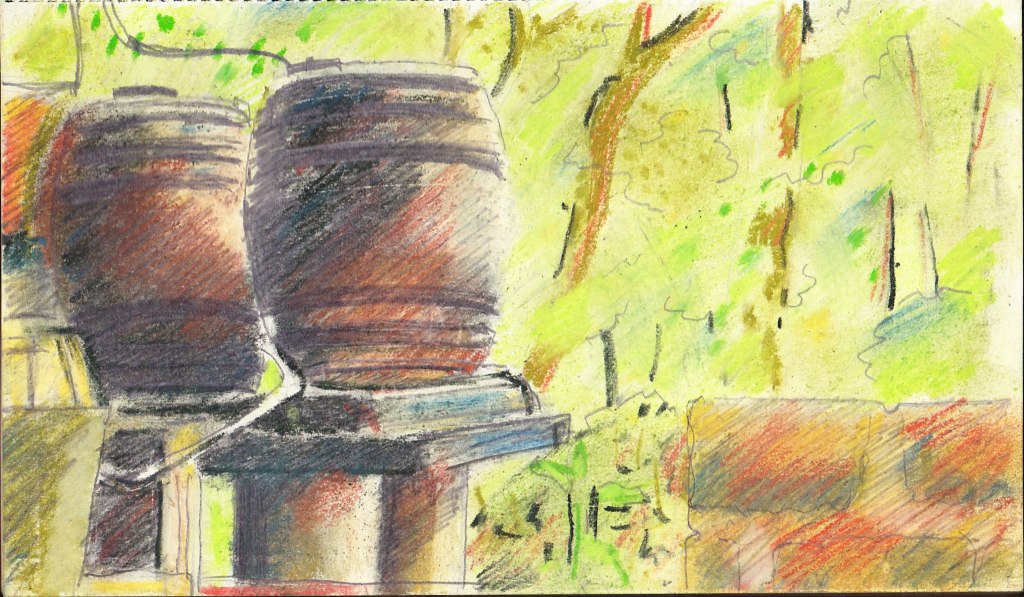
Behind the kiln was a couple of barrels up on a make shift sort of shelf and these were the oil barrels that I hadn’t really noticed before. We trekked over to the drive way and filled petrol cans full from the oil tank and barrowed them back to the kiln. We filled the barrels and jumped down to activate the blower.

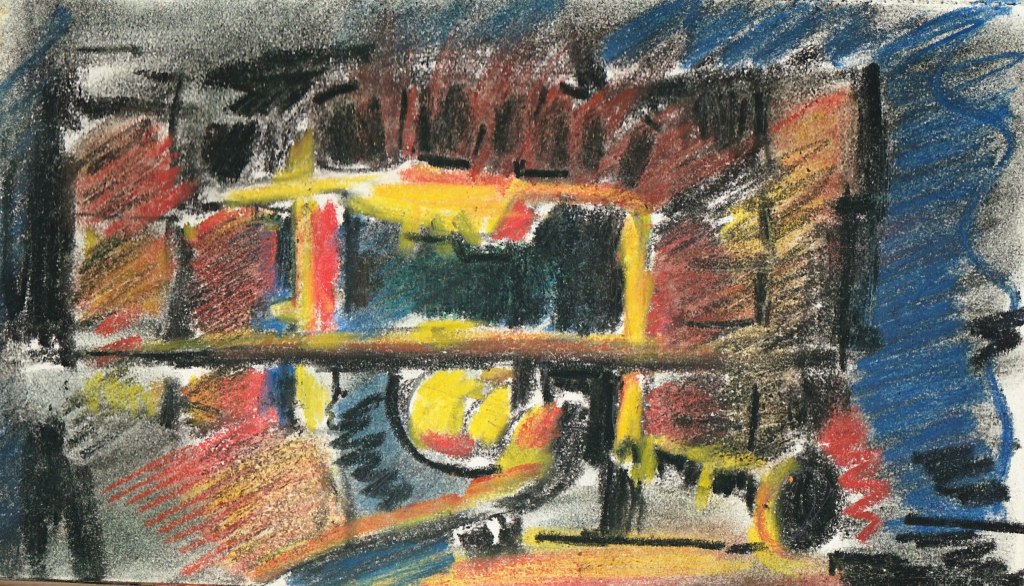
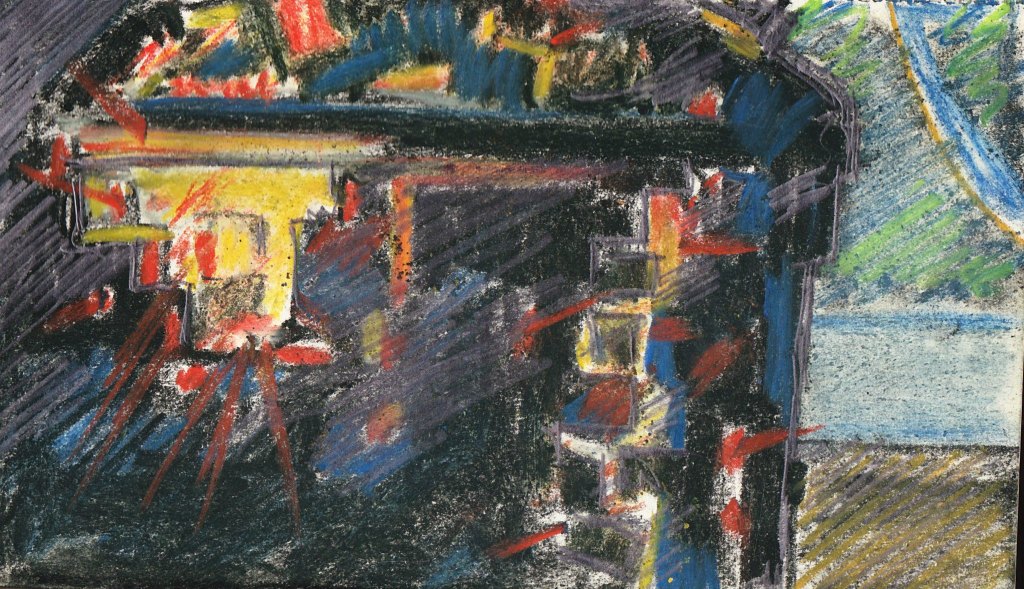
Now came the crazily exciting moment as Michael turned the tap and the oil dripped down and was shot into the fire box by the blower. Woh! I jumped back in shock as the fire box roared and exploded into life red hot and angry. I stood mesmirised wondering if the delicate pots that were trapped inside would survive this baptism of fire? What expectation and anticipation is generated and I couldn’t wait to see what happened next.

To be continued:
The Firing

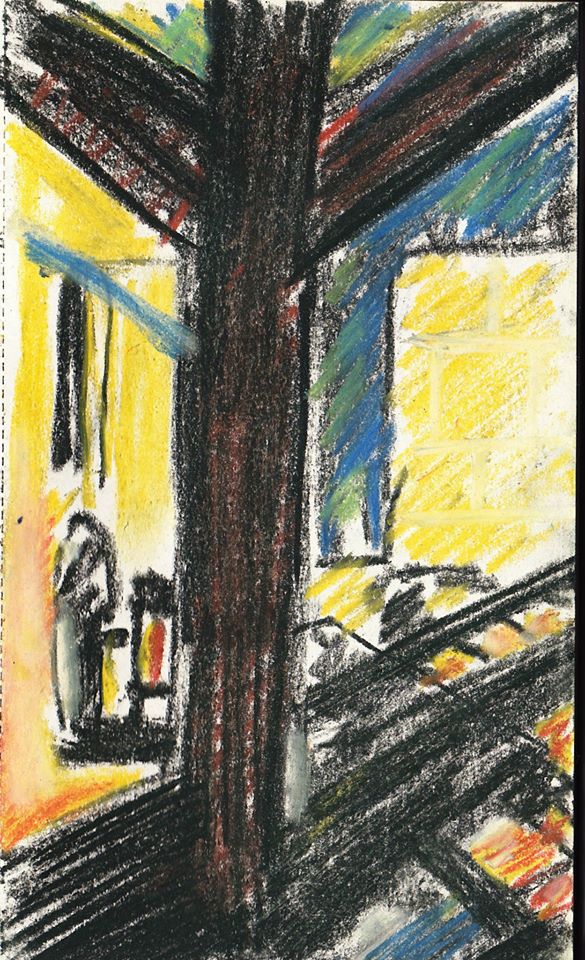
Firebox – Pastel and charcoal
Reaching temperature – the reduction

Well, I did go back and with what seemed an endless summer of struggle and the total faith and enthusiasm of my tutor I began to make progress.

I spent time watching Michael on his wheel turning out perfect mugs, jugs and various other decorative pieces. He could produce a whole set of six pots, a milk jug and sugar bowl to my one rather clumsy lumpy mug. Still it was progress and I began to enjoy it.

After letting your pot dry to leather hard, you then turned and trimmed your pot and carefully took off excess clay with a special wire tool that was hand made. like most of the things in the pottery, including the foot wheel that I was using.

Like most things in the pottery studio, I learnt the hard way. I was beginning to find out that every stage of the pot’s progress was fraught with danger and disaster. You could destroy you hard earned pot at every stage. I took off too much and the pot developed a hole, I didn’t centre the pot on the wheel sufficiently so it wobbled and one side was thinner than the other. It took me ages and meanwhile a whole kitchen set was materialising over the otherside of the studio magically by the master. I did feel at times feel I could strangle him and the clock ticked on.

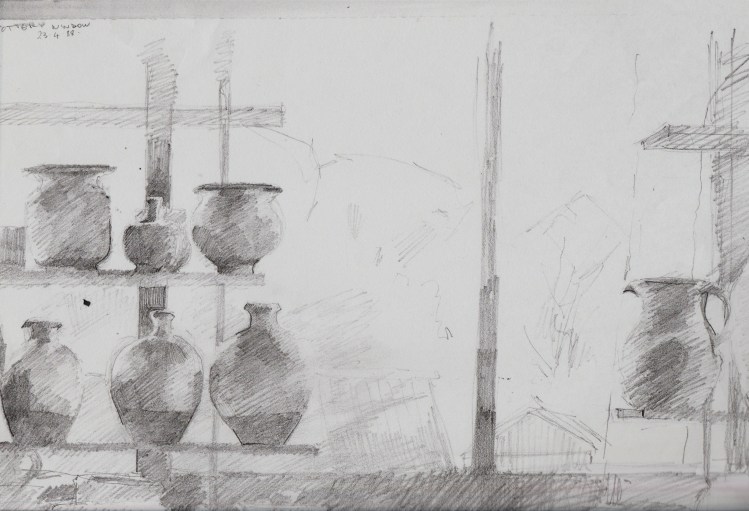
These leather-hard items were then left to dry and stacked on shelves around the windows. Each time I came back I found my pots seemed to manage to change and become dumpier and clumsier everytime I looked? This seemed to be the case through every stage, I would make an item and think, thats not bad, nice shape, good size etc. only to find when I returned the next day it had mysteriously changed and looked totally inadequate.

The Oil barrels

To be continued……

Summer in the Garden cont.

As I worked, a little old Harrods van trundled up the narrow drive and the little lady of the house came and took a piece of meat and a wholemeal loaf.

I worked on until I heard the sound of a bell calling us to lunch. Michael used to say, much later that when he first encountered this sullen shy adolescent, that he tried to reach me, but couldn’t make any connection. He thought me, very difficult and rather rude. We laughed about it later and I said I found him difficult too. Like poles of a magnet repelling each other, it was Denis who with great patience and love, had to try and bring us together to act as the catalyst. With care he prised out a response and the conversation began to flow.

Lunch, to me was a curiosity; very different from my fair of white bread and marmite sandwiches I had at home.

As mentioned before, Denis, the market gardener; we have to give him credit for being an early pioneer of organic and sustainable living. He really believed in the health giving properties of plants and the importance of working organically and using the land for livelihood and this could be linked to his interest in ceramics which is so much a part of the geology of the locale. Using sand, local clays of the area; “these gifts of nature to create beautiful things was his ambition.”

*

I was introduced to many new foods that I take for granted now. Sweet corn, sweet peppers, garlic, artichokes all of which I had never eaten before. The meals were a hodge – podge of stews, curries and salad dishes normally cooked by him or his mother. To eat we sat perched precariously on old wooden chairs around a gate leg table in the living room.

Michael and Denis talked about everything from the price of oil, to world politics and religion and were on the whole very disparaging. I didn’t join in the conversation as I didn’t feel qualified, being in only my teens and feeling that this was a new age for me and I wanted to feel optimistic and forward thinking.

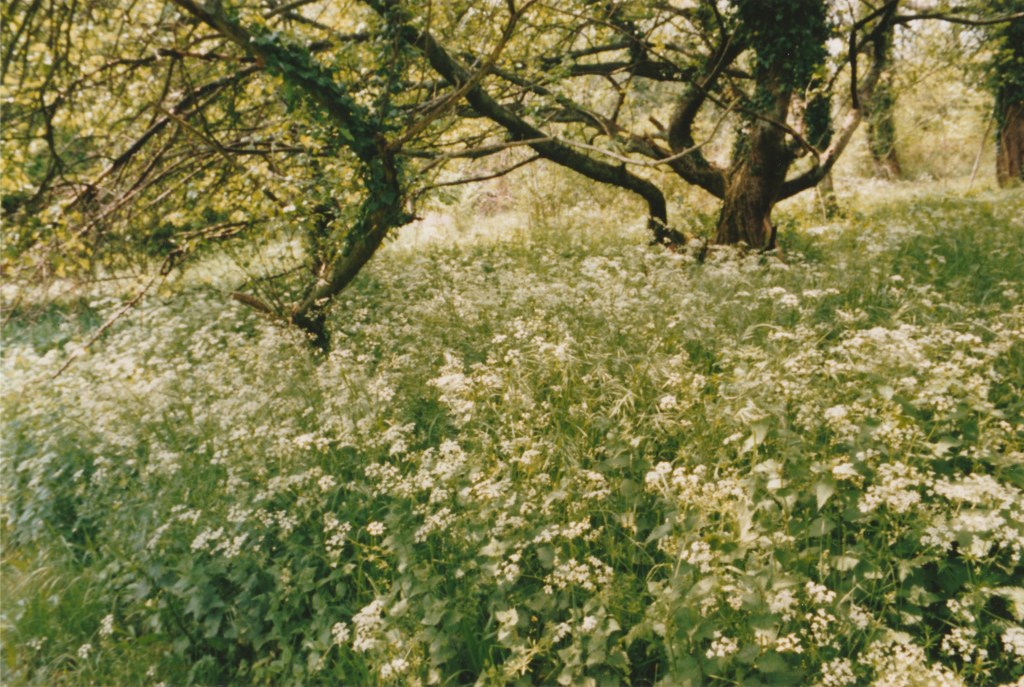
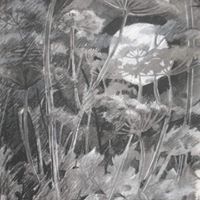
After lunch it was time for the pottery. We headed down the slope between the apples and the cherries, past the hog weed and scabious acting as landing pads for the peacock butterflies and myriad insects buzzing, hovering over nature’s larder.

Denis gave me a talk about the various clays and what clay is made of, he called it “the body”. Most of it I can’t remember, but he introduced me to silica, feldspar, china clay and grog. He set me the task of weighing out the clay and demonstrated kneading which took some doing. He then set me on the foot wheel to centre the clay. Well, I threw the first lump on the wheel rather haphazardly, with a shower of water splashing, I wrestled and struggled and pushed and pulled. At first, I couldn’t decide when it was in the middle and like all beginners I had disappointment after disappointment. It drove me mad, particularly as Denis seemed to manage it with so much ease. Disaster followed disaster and as if the clock had suddenly speeded up, it was time to go home!

There was nothing to show for 3 and half hours work except a pile of very wet slushy clay called slip, very appropriate in my case and one extremely wobbly half collapsed, vaguely bowl like pot. Was I cut out for this? Painting seemed so much easier than this. 

Now, cycling home I felt completely drained, deflated and depressed, would I go back again?

Summer in the Garden

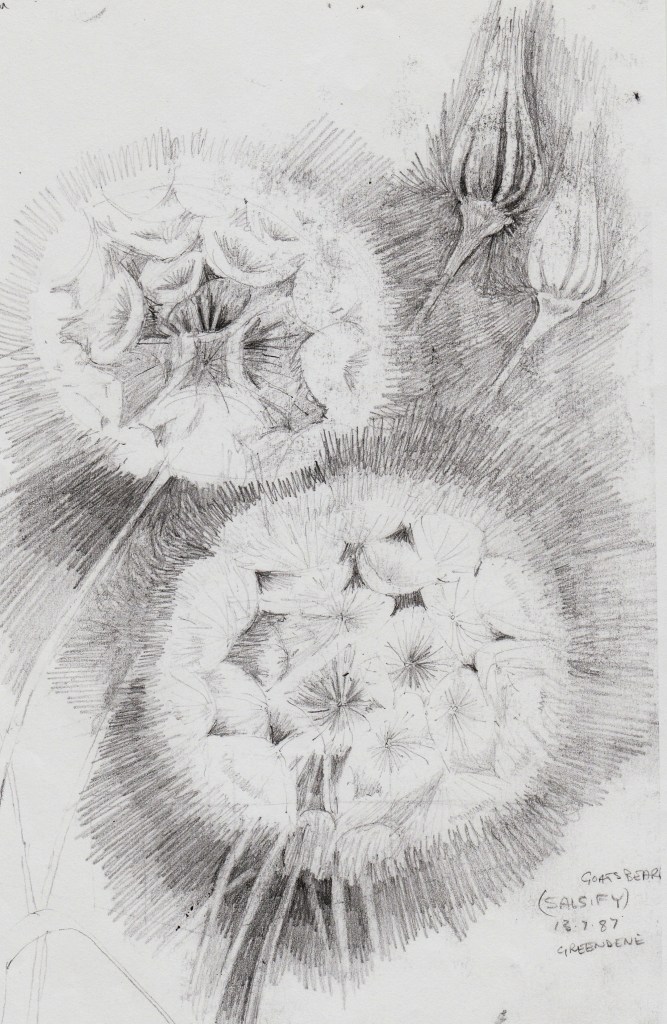
Goats Beard ( Salsify)

I remember it as a rather damp, grey sort of summer in the mid sixties when I commenced my summer job working in the garden. I can remember listening to Simon and Garfunkel and Thunderclap Newman on the radio. Sometimes on good days I cycled all the way pedalling up and down the various hills that you don’t really notice when you are in a car or bus. I would then work all morning in the field and happily ride home in the late afternoon early evening, oh the stamina of youth!

It is now time to introduce Denis’s partner to the equation, Mr Michael Buckland. As I arrived early that first morning, he zoomed up the drive in the ubiquitous Austin Mini, turned abruptly left with a rough sound of crunching gravel, reversing into a small space beneath the shade of a giant beech tree. I am not too sure if this was the first time of our meeting? I may have met him on the stall, but at that time I was so focused on my mentor that he didn’t figure much in my consciousness.

Michael had a rather swarthy complexion, a protruding jaw, unkempt black hair that kept falling in his eyes that were dark and deep. He had a rather gypsy like appearance and I took a dislike to him immediately! He was an interloper in my rather selfish and insular self absorbed world. Over time my views of him changed significantly and we became firm friends. He was like an older brother to me, full of wit, deep thought and a master of the pottery wheel. An unlikely pair, we were thrown together initially by our mutual love of the place. I have always thought that those that turned up at the door, including abandoned cats and dogs, were somehow orphans of a storm, outcasts in a crazy world and it became our sanctuary.

The plan was, in exchange for helping out in the garden in the mornings; Denis would then teach me the rudiments of his craft in the afternoons. Michael directed me in the garden and I started by cleaning cloches, making seed trays with a strange contraption, weeding out between the rows of carrots, onions and artichokes. At first I found it hard work and I seemed to notice every ache in my bones and back, but after awhile I found the quiet, gentle, rhythmic routine really quite contemplative. I enjoyed the sounds of the wind, the smell of elder and the beauty of my surroundings. If I stopped and just listened I could sense a still silence that brought a real sense of joy and other worldliness.

“My heart flies up

Amongst the shimmering ash tree

A glow of azure between the leaves

My heart flows down

Amongst the damp dark grasses

There the silent slugs’ world lies

Down, down beneath, where slow time wanders

Where shadows shift in the spiders eyes

And the song of startled thrushes cries

All around this tangled land”

Bob Meecham

First Days continued

Under the Old Apple trees

I can’t remember how many times I helped out, probably only a few times. I did meet some interesting characters, many who like me had just happened to be passing. One rather eccentric character who I do remember very well was an extremely tall slightly lugubrious fellow called Nicholas Rocke. Like many tall people he was very self conscious and to cover his shy nature had developed a rather supercilious, reproving air. I was initially very daunted by this lanky condescending quintessential art collector. I learned over time, with his many visits that he was a passionate advocate of the pottery and really had a soft vulnerable centre. He was a most generous man unique in many ways and perhaps another of those orphans that washed up on the shores of Greendene. Together with his interest in music, he was very much a part of the scene and played and sung on the old piano such favourites as Vaughan Williams and other English composers.

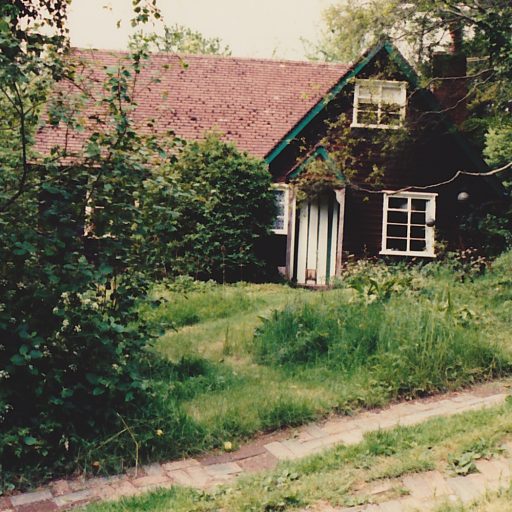
Hogweed and house

On one of my visits to the stall to my horror, Denis suggested Nicholas could take me home in his car. As I found him rather terrifying, I was some what reluctant to take up the offer, but unable to find an excuse not to, I agreed nervously and got into the front seat with trepidation. Once on our way, he tried to break the ice by asking me about my interest in the pottery and about my painting and I managed some how to talk about my art and my wish to go to art school.

This brings me on to one of my many discussions with Denis while waiting for the curious to come and visit the stall. I had showed him my sketches and he was most generous in his praise. I had mentioned that I wanted to go to art school and he argued against it, sucking on his gauloise cigarette saying, it would force out all my naïve, pure unaffected creativity? It’s something I have never forgotten and often consider how things might have turned out, if I hadn’t ignored his advice. When I consider and look back at Denis’s life style and his approach to his craft, I can understand his feelings and anti establishment stance. He was very much the supporter of the individual and the loner, of the artist who couldn’t sell his work. Technique and style had to be subservient to exploring your craft, being daring, in order to create a work of uniqueness.

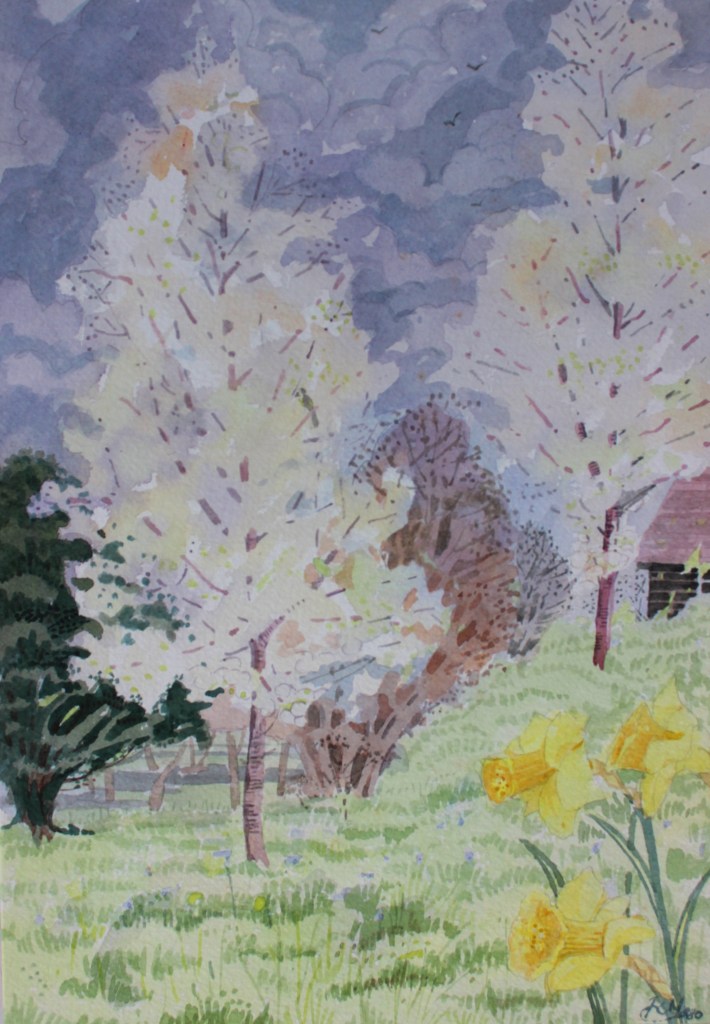
Hogweed and Moon – Bob Meecham

My First Day

Greenddene Studio

A Summer Sunday, I was waiting at the bus stop with a little trepidation, as this was my first visit to the little stall up the winding lane. I could smell the fresh grass cuttings and the wood scent of the bus shelter. It was warm with that clammy lazy feel of a summer’s day. This was before the crazy mad rush of a Sunday that we now have to live with.

Eventually the old green country bus appeared lumbering its weary way towards Leatherhead and final destination of Guildford. I clambered on and set off up the stairs as this journey would take sometime. I enjoyed the high perspective views over fences and into gardens and could watch the village activities, a frozen moment like a snap shot. We trundled through Leatherhead and stopped at the bus garage to change drivers and I dozed in the heat.

Eventually we passed the Effingham crossroads and drove into the tunnel of trees and headed down the steep hill where I was to get off. All was quiet and sleepy. I waited at the lane end and eventually a little green, rather battered old van popped along and stopped for me to embark. There was Denis with a broad smile on his face, opening the door for me to get in. Off we went up the familiar narrow tree lined lane and on further into the canopy of trees. I relaxed and noticed the old sacks and tomato trays in the back as we bowled along.

Suddenly we swerved, turning into the driveway and bumping up the brick drive arriving in a shower of pebbles and twigs.

“Well here we are!”

I helped Denis load the van with the pots, putting them carefully in the tomato boxes and we set off down the drive again. Here, we set up the ramshackle stall and found more items tucked away in the caravan. I enjoyed unwrapping old newspapers to reveal the fascinating pieces one by one, like it was Christmas. Each pot, bowl or vase was manoeuvred into place and Denis added a price label to each one. Then we sat down to wait hopefully for some visitors.

While we sat, Denis talked animatedly about the pots. He talked of Tenmuko, Chinese brush, sang de Boeuf, ash glazes and tea bowls, another language to me at the time. The one thing I always remember is that he said, “In China the best art, ceramics, painting, and poetry had to be completely natural, like a piece of nature itself.”

When I looked again at some of his pots I really could understand this “Zen” like concept and felt that Denis’s pots really did appear almost like a plant growing out of the soil. The ash green glazes, the mottled browns and blacks merged completely into their verdant surroundings. It came to me later, that nature and its capacity for endless variation was some how embodied in the pots and reminded me years later of Hopkins wonderful evocation of nature in his verses:

Glory be to dappled things –

For skies of couple colour

For rose moles in all stipple upon the trout that swim

Fresh- firecoal chestnut falls; finches wings;

Landscape plotted pierced- fold, fallow, and plough,

And all trades, their gear and tackle trim.

Pied Beauty, Gerard Manley Hopkins

*

Denis, Brief History (Pt 1) completed

In 1952, at the time of writing Pennies from Heaven and Earth, we find Denis working up in the City as a solicitor, having to try to make ends meet. It was while on the train back to East Horsley that he got into conversation with Michael Buckland.

Michael was an unhappy soul, lacking in confidence and persuaded by his forceful father into an office job totally unsuited to his nature. He was somewhat dyslexic which at that time was unheard of and suffering from an education in the war, which could be said to have been at best sparse and old fashioned.

 I would love to have been a “fly on the wall” during this chance meeting. Imagine them sitting in the carriage. Denis rather over wrought and wishing to be back in his idyll, while a grumpy disillusioned Michael sat idly looking out on post war ravaged England. Whatever the conversation, the outcome was that Denis invited Michael to work in the garden at Greendene. This was much against his father’s will, who felt that Michael should have “a proper job”.  

So, Michael started in the garden, after David Martineau, Denis’s previous helper,left in that year.

Unfortunately, very soon after he was called up to go into National Service, for which again he was an unlikely candidate. He told me he got by partly because he didn’t smoke, by selling his fags to the others and therefore keeping in their good books. He learned to drive and enjoyed the relative freedom of driving rather than routine marches and other soldierly duties. Like Denis, he got invalided out of service, this was due to contracting glandular fever which lasted some time and kept him away from Greendene. Eventually however, he got back to the garden that was now much in need of his strength and zeal, to help support Denis who was really not cut out for hard labour in the field.

Denis Moore, a Brief History (Part 1)

According to what I have gleaned from various sources. I will try and piece together some sort of timeline.

Denis was born near the start of the twentieth century in 1908, possibly at Haigh near Wigan in Lancashire. At 13 he attended St Bede’s Catholic college in Manchester. There he studied History, Greek, Latin and Chemistry. This last subject, being useful later during experimentation with glazes and reduction firing.

This typical middle class upbringing leads him towards the study of law and in 1931 he passed his final exam. He applied for various jobs including teaching with the Egyptian Ministry of Education, but he was unsuccessful. Around this time he discovered the little plot of land and small house at Greendene and settled there along with his mother. The whereabouts of his father was unknown.

The grounds at Greendene were split and Denis just had the west side of the driveway and only later bought the other piece of land as described in his description “Pennies from Heaven and Earth”, an article written for the Pottery Quarterly in 1959.

It was just after the war that, he began an interest in living off the land. He had suffered during the conflict from several illnesses including the serious rheumatic fever and also a duodenal ulcer. I think that this was to some extent an effect of the trauma of the war and influenced him to find a less stressful job out in his country retreat. Leading later to try and live a more sustainable, and rural existence on the land and live a more healthy life.

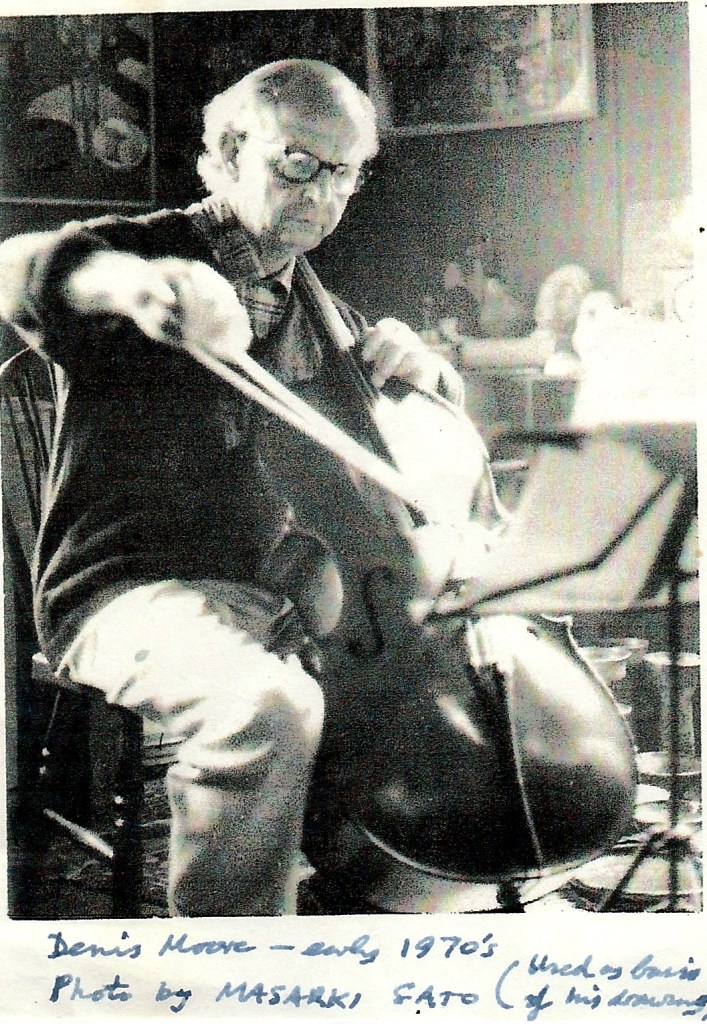
His interests were also musical and he took Cello lessons and was involved in the Surrey orchestra. Later, it drew a number of musicians up the little windy path including well known cellist Julian Lloyd Webber and during the sixties the rock group Moody Blues.

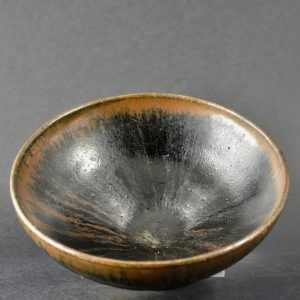
Early-Chinese-Brown-Cream-Glazed-Pottery

At some point during his upbringing he had stayed with a wealthy family in London, who had a collection of Chinese ceramics which must have stuck in his mind when he was considering how to supplement his income from the market garden. He entered into correspondence with the now famous Bernard Leach, who more than anyone revived the craft of “Studio” pottery in Britain after the war.

Coincidently, also around that time in 1949 there was an important exhibition of Sung dynasty ceramics at the Oriental Ceramics Society. This too, must have encouraged Denis to get building a small studio

My first encounter concluded

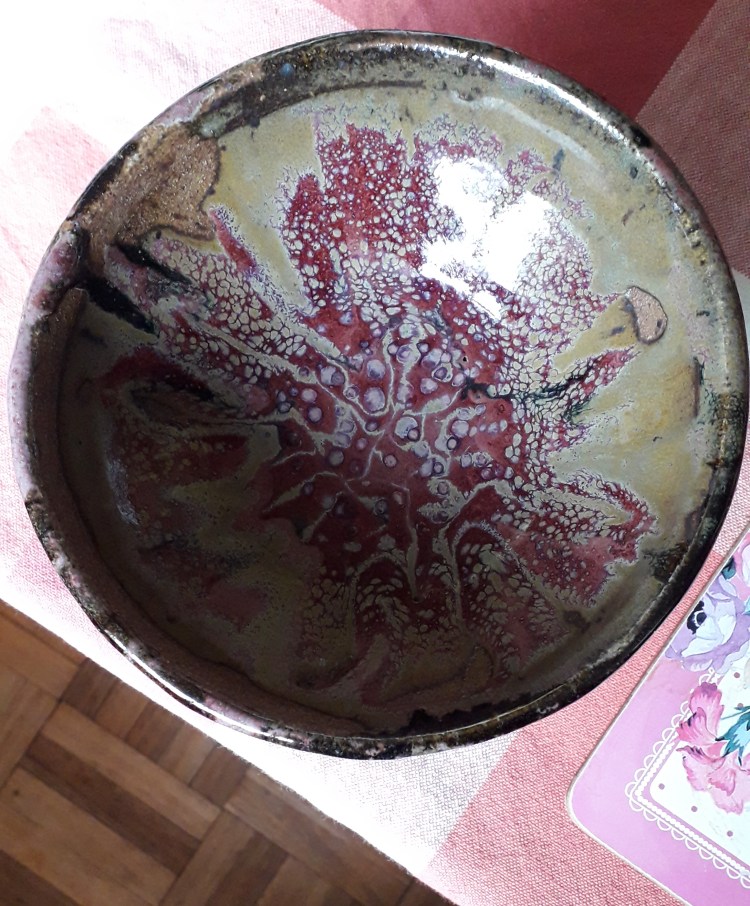
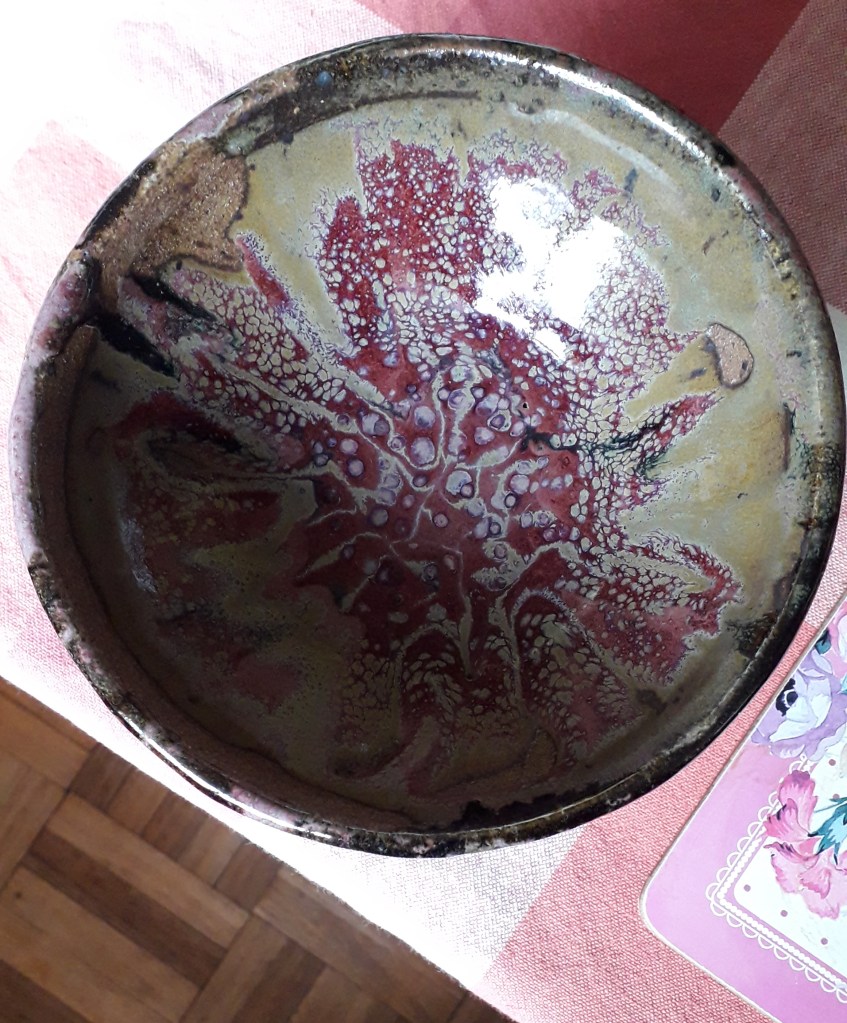
Reduced fired Bowl by Denis Moore

     After some time talking, we headed off down the little winding path beneath the gnarled old apple trees and the magical cluster of cherry trees that held a fascination for me and of course the Chinese.

We passed the greenhouses full of ripening tomatoes, passed the artichokes and the market garden veg. and arrived at the bottom of the slope to see a large long barn. When I entered I smelt, what became so familiar, the damp, paraffin oil and cool clay smell of a pottery. There were various types of foot and electric wheels, a kiln filled much of the space with a myriad of unfinished pots in various stages of completion. Behind the pottery was a wooden shelter covered in corrugated iron under which were two proper brick kilns, with chimneys. My father and the potter talked about oxidisation and reduction. Where the pots were placed gave different results and how the atmosphere changed the colour of the glazes? This I only really understood later. At present, the kiln appeared to be abandoned and consigned to invasion of ivy and “Old Man’s Beard” I couldn’t believe this would ever be used or would be workable, but I was so wrong!

Finally, I don’t know when it was arranged, probably my desperate mother, who wanted to give me a much needed push to get me more engaged and out of my sullen silences. It was suggested that I could help on the stall at weekends and possibly next summer come over and help in the garden. In return, I would be given a chance to learn pottery in the afternoons. Well, that was my introduction to the Greendene world and the beginning of my love affair with this beloved place. It was one of those moments in time that are almost unnoticed, but looking back, are etched on the memory, never to be forgotten.

First Encounter continued

We were invited up to the house, but my mother stayed with my grandmother by the car as she was wobbly on her pins. As we approached up the brick driveway I noticed a very small stooped figure leaning to feed the bantams that clucked and strutted round her ankles. They, in fact roamed the grounds and even in the house, laying eggs on the stairs! This dark shadowy figure was the mother, with grey hair and black formless dress in slippers; she was the archetypal matriarch and ruler of all she surveyed. The house was a wooden affair that was clapboarded and creosoted, deemed to be a wedding present to a member of the Guinness family. This has been called into question now, but it gave the old place a rather quirky, beach hut, but mystical fairy tale air.

On stepping into this sanctum, I could smell a scent of warm creosote and my eyes had to get accustomed to the dark panelled hall way. As we walked down I remember seeing a large Chinese vase and a wizened looking cactus growing out from the rim. I discovered later that it occasionally bloomed with magnificent crimson flowers. 

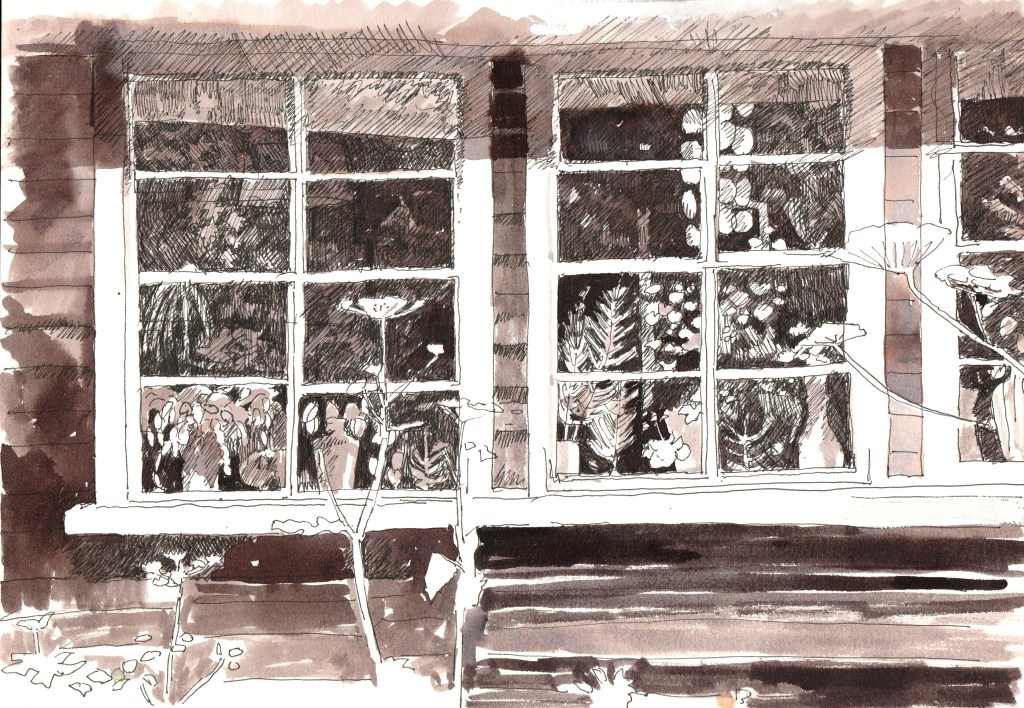
We were invited to step into the large wood panelled room, that brought the summer light back. It filtered through the 1930’s metal panes of glass and dappled the furniture with shadow and light, like tiger stripes. The atmosphere was green, soft, and liquid, partly due to the close proximity of the tall cherries looming over us and threatening to engulf the room. Dusty particles were suspended over the cluttered surfaces. I marvelled at the sheer untidiness with Listener magazines piled high on the floor, low tables laden with art books, pamphlets and ashtrays. It appeared so remarkable because my father, who was so strictly tidy and always waiting to throw things away. It wasn’t unheard of to find my mother rummaging through the dustbins trying to find an article that my father had sentenced to an untimely abandonment.

Gradually my eyes began to rove around the room and I began to notice the paintings. One, I remember stood out for me. It was of a blue glass vase with bright Chinese lanterns and quite clearly painted in this room. On another wall there were watercolours, very accomplished, of landscapes in broad blocks of earthy colours. They were paintings of a friend of Greendene, Gordon Randall. Later I got to know him and his work more intimately and visited him and his very talented wife Barbara at Frimley. Their house was very ordinary and comfortable. Whereas Greendene on the other hand was really like an “artist’s” place should be and I felt an instant rapport and love for its ramshackle nature.

While my father talked chemistry and geology I wandered amidst this treasured chaos. I was in a daze. This was my “Garden of Earthly Delights” my “Shang RI La”

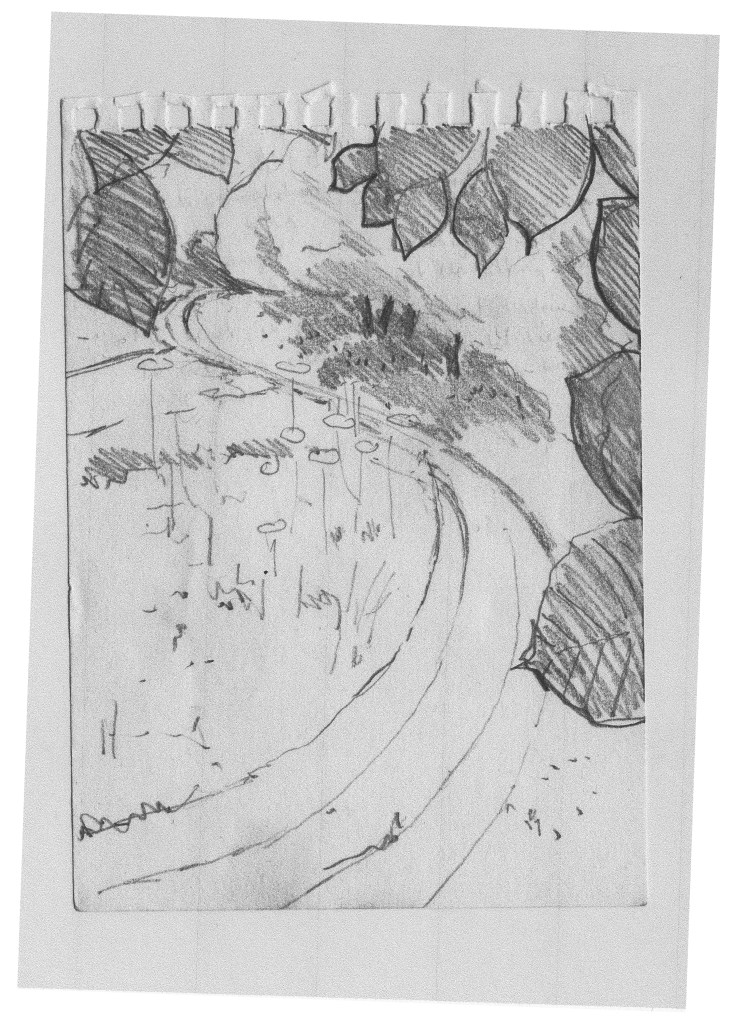
Approach to Greendene – Sketch Bob Meecham

Continuing my ambling around the room, I noticed the large logs piled on the hearth of a beautiful art deco brick fireplace blackened and charred evidence of it being in constant use. On the other side of the room there was baby grand piano with music manuscripts and music memorabilia Then, I turned and focused on the long old wooden bench immediately below the windows. This was covered with wonderful bight red and purple bowls all different and of various sizes like the ones on the stall by the road.  Rich copper, deep vibrant chocolate black and along side these, other exotic nature- like shapes that appeared to have grown out of the soil. At that time, I knew nothing, of Zen and Taoist beliefs, of Chinese culture, its obsession with the natural world and the undercurrents that govern laws of the earth, how these were translated by artists, poets and thinkers, into the arts and crafts of many past dynasties. 

To be continued: