This was the 60’s and what seems a million years ago. I was sitting in the back seat of my father’s car. Morose, is probably not the word, there may be a better one; I was 13 or 14 with issues. My grandmother, still, at that time called “Nan Nan” enjoyed trips out into the Surrey hills when she came to stay with us. It was a time before the oil crisis and the carbon foot print. I am not sure how my father, who worked long hours, new so many country roads. He seemed to have a perfect map or gyroscope in his head, a human Sat Nav!
Anyway, we were out and about on this fine Sunday afternoon. My eyes were fixed on the lane and overhanging trees, fascinated by the rope-like roots that embedded the chalk banks, washed by rain that had strewn knife like flints across the narrow road. My head nodded against the glass and with pangs of anxiety I thought of my return back to school in a few weeks time. I tried to concentrate on the winding view that reminded me so much of Graham Sutherland’s Pembrokeshire lane paintings.
We climbed a hill up towards the North Downs Way, the track that took the pilgrims on to Canterbury. Just as we turned a sharp bend my mother; I am sure it was my mother called out,
Stop!
Look, there’s a gypsy caravan. Sure enough, there it was and sitting next to it Buddha – like, sat an elderly gentleman with a lose check shirt and baggy trousers.
I hadn’t notice, but along side this guru, was a handmade trestle type table with what appeared to be strange pottery items. I didn’t know at the time, how this chance encounter would change the direction of my life.
So how can I describe this first meeting with this Chinese influenced studio pottery? They were unlike any crockery I had ever seen before. Cups and mugs of sombre natural colour, deep rich greens, shiny dark blacks with flecks of brown. Bowls of clear turquoise blues and creamy golds were set against blood red vibrant violet flecks on dishes and plates. They’re were tall odd shape objects that I later gathered were incense burners, robust looking teapots with bamboo handles, most fantastic. How crazy was this place, set in the very middle of a sedate orthodox county? Was it a time warp, someone replanting a chunk of ancient medieval orient into our post war consumer based society?
What also amazed me was that my father was also intrigued and began a long conversation with this slightly unkempt casual man who oozed a sort of magic energy and appeared to have a smoke of care and deep thought about him. To me, he appeared as a man living a dream, a true artist, like Monet or Rembrandt. He talked animatedly about his pots and his discovery of ancient glazes, Sang de Boeuf, the “blood of the ox”, Celadon and Tenmuko.
This blog is a stab at writing a memoire, both of the unique and marvellous Pottery and market garden and how I became involved with the life and philosophy of Denis Moore and his rural idyll.
Prologue:
I start with the very interesting article Denis wrote in 1959 which outlines his interests and ideas and gives a potted history that puts my humble writings into context.
“Pennies from Heaven and Earth”
An Article from Pottery Quarterly 1959
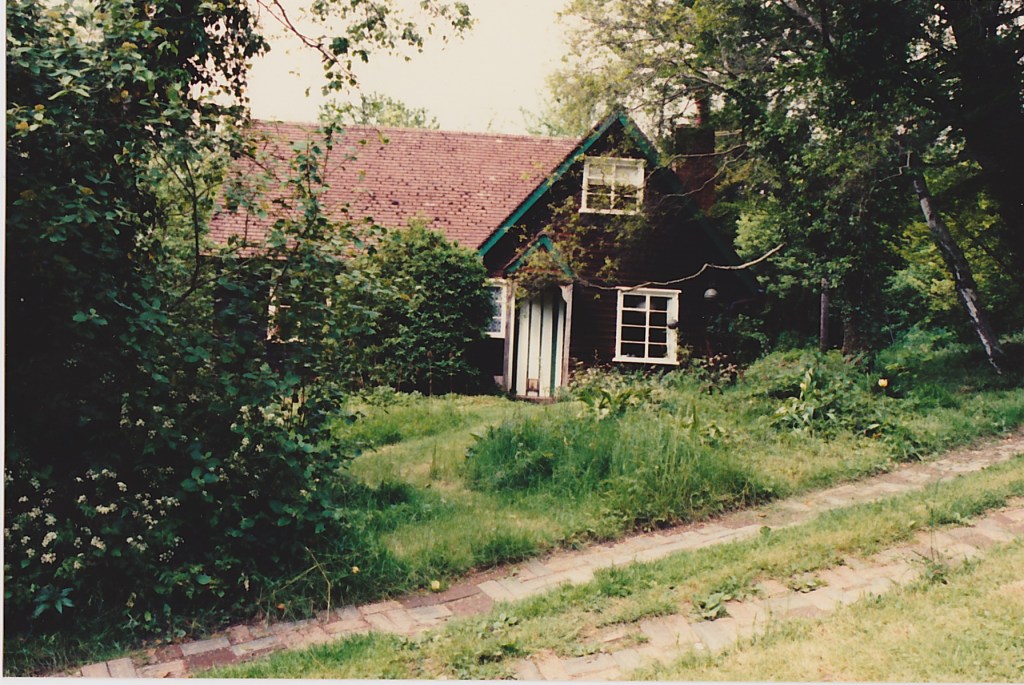
As an armchair “philosophical anarchist” I could regard any sayings of politicians as forming a basis for vade-mecum: yet I remember, way back in undergraduate day, a remark Lloyd George made when he was establishing his famous fruit farm at Churt – not far from here. “The English skies” he said, “rain down fatness on the land.” So when, twenty two years ago, I acquired a small cottage in Surrey (then recently built in the colonial style by my friend Brian Guinness) plus nearly eight acres of wood and virgin downland in the midst of Shere – which with the North Downs hard by, is still by far one of the loveliest parts of Surrey – I tried to imagine how any surplus fatness could be extracted from my few chalky acres to yield me a simple living.
The site is divided roughly north and south by a path some hundred yards long leading from the Shere road to the cottage. The soil here is a flinty loam and – judging by the profuse growth of wild strawberries beneath the typical downland vegetation of thorns, wayfarers, cornels, etc.- should, I thought be capable in time of yielding some surplus fatness. The westerly portion, less steep is predominantly of marl-clay-with-flints structure- again typical downland vegetation. At its northern crest, on a small plateau facing south is the dwelling. The whole area viewed from above would have the appearance of a glen or natural clearing in the midst of a forest.
Having fallen in love with the beauty of the place, my plans and dreams centred around its horticultural and (perhaps) other potentialities. I asked myself: With this surface marl clay and all that wood about the place, what could (or could not) be done?”
The chief deterrent to any Blakeian Translation of immediacy of thought into immediate action (“Without which,” the master says, “therein madness lies”) was the obvious gargantuan task of necessary minimal clearance. At that time, pots had borne themselves in upon my aesthetic consciousness through the wonders of the great Chinese exhibition at Burlington House in 1935 (what presumption!) the strength of a Staite Murray exhibition, the sight of some Leach pots and the purchase, in 1937, of a Leach soup set! Also I had some two years shared a lovely house peopled by a wonderful small company of late Sung and Ming monochromes – sang de Boeuf, etc and some Chinese stonewares and celadons. I was thus in a sufficiently continuing state of receptivity and enthusiasms to think ( some years later) that anything might be possible after reading Leach’s book and seeing the wonders there displayed.
But the war had come and the rigours of army service and subsequent acute illness (rheumatic fever- which meant my discharge in the midst of all the turmoil) effaced all else – even for a brief moment, during the still small ours of a bitter winter morning in the Royal Herbert Hospital, Woolwich, the desirability of life itself.
However, one glorious day, I found myself back again in “ my own native land,” with my nostrils, eyes and ears rejoicing in the rich conglomeration of scents, sights and sounds of Surrey in August. Here I was, in the midst of a crumbling world reeking with destruction, magically translated to this little paradise of my own choosing (soon to be nearly obliterated by a Molotov “bread basket”!!): and then I resolved to construct my little world, hoping, against reason, with the Chinese sage that the skies might “remain high and the Emperor far away” Slowly- as soon as I had the strength- I began the work of clearance and cultivation on a single acre. During the next three of four years I learnt by the hard way, by many trials and many errors, and alone except for what casual help I could get. The local Scouts were keen to chop down bushes as practice in axemanship – but less so to excavate the enormous tap roots of thorns!
While learning bow best to manage cloches the making of compost and the mysteries of three strip rotations I tasted the rigours of firing with wood a not too cleverly constructed two chamber kilns. I soon realised that single handed faggot-firing for stoneware after some thirty hours wood-stoking might easily become the experience to end all experiences. So, after one further flurry with the grand feu- all this time for salt- glaze – I humbly climbed down to more galena temperatures. Then, ten years ago, I met Heber Matthews, who with wonderful patience, knowledge and skill, helped me to build “ a proper kiln” as near “all-purpose” as one could wish. This I fire with wood and oil latterly with the aid of a burner generously given to me by another staunch friend James Walford. Now, stonewares are again possible and I am avid for ashes from the trees on my ground. These include most of the varieties in the British arboretum – even such comparative rarities as holmoak and aspens.
The link between the mineral trace elements in the soil vitally necessary for plant growth, health an fructification, and the residual containment of any surplus non- assimilable amounts of those elements in the woody fibres of plants and trees, an their release by reduced firing in stoneware glazes to give strange and lovely effects of colour and texture is, for me the most enduringly fascinating of empiricisms. So her I am at the end of sixteen to eighteen years of “residual, self- conscious living” – still alive and making my living by selling my products” in the teeth of the most wide- spread industrialisation and commercialism it is possible to imagine.” We are to such a large extent self- supporting that, like the Dordognais, our motto could well be un peu du tout; and the work is so all- absorbing, with ever varied interest, that personal wants, over and above these very solid satisfactions, are few. You have to be a gambler to play the soil game; but if you play “with” and not “against” you will be vouchsafed in due time a share of that fatness which “the skies rain down.”
Now I have about a thousand cloches, a greenhouse, frames, a cultivator, flame gun and irrigation system. I have my own stoneware body, compounded of a local red- burning siliceous clay, which will stand 1300C., ball clay and an almost pure quartz sand which is washed down from the Netly Heath deposit-a –geological formation unique on these inland uplands and named in the Government Geological Survey after the Heath, which is no more than five thousand yards from my door. A marine deposit, one of its products is this pure silver sand-a lovely medium for opening and strengthening clay bodies.
As I have said, my clay is marl- exactly similar, when fired to the body of a small twelfth- century Sultanabad Persian bowl in my possession. Working in marls and calcareous earths, one finds fossils, and some of the most interesting and spectacular are the “shepherd’s crowns” of fossilised sea urchins. These small conical objects varying in height from a quarter to two inches, with symmetrically disposed, deeply incised converging pairs of lines running form tip to base. The hall-mark of a Sultanabad bowl is the under glaze painting, on the back from rim to foot, of this same pattern. I feel that the Persian potters, working in the similar marls must frequently have found such fossils and copied their striking symmetry in their decorative motifs.
To finish-nothing which has been done would have been possible, but of the lively encouragement and indomitable optimism of my wonderful mother, who live with me and shares bravely and without complaint all the ups and downs. My only helper (now my partner) for the past six years has been Michael Buckland – Surrey born and bred- who came to me on a rebound for frustration from a parentally- imposed clerking job in the City and is now a highly skilled horticulturalist and craftsmen potter.
We grow: Early spring flowers and salads; cloched runner beans, French beans, carrots and peas; cloched strawberries and tomatoes; greenhouse cucumbers and tomatoes; cloched cantaloupe melons; summer flowers of all kinds: pot plants; winter greens, parsnips, celery and leeks; apples and plums. James Walford is helping to start a small vineyard.
We make: In Stoneware- simple ash- glazed soup bowls and plates, plant pot holders, vases, mugs, jugs and beakers. In galena and majolica glazes – simple earthenware decorative plant pots slip trailed and decorated dishes, coffee cups bowls, jugs, beakers and vases. Plant pots for the garden. Compost heaps, mistakes, music and a precarious living.
We have: 80 – 100 poultry, five ducks and four near-human cats. Never enough time in the day.
Our mottoes: Un peu du tout. Return to the soil more than you take out. Ars longa vita brevis.
Our aim: A good life – the more “residual” the better!
P.S.: We supplied from out gardens all the fruit, salads and vegetables recently eaten by 103 people at the Potters’ Day at Oxshott. I hope that there is no record of any ill effects!
This is the first post on my new blog. I’m just getting this new blog going, so stay tuned for more. Subscribe below to get notified when I post new updates.


 Bobs Blog